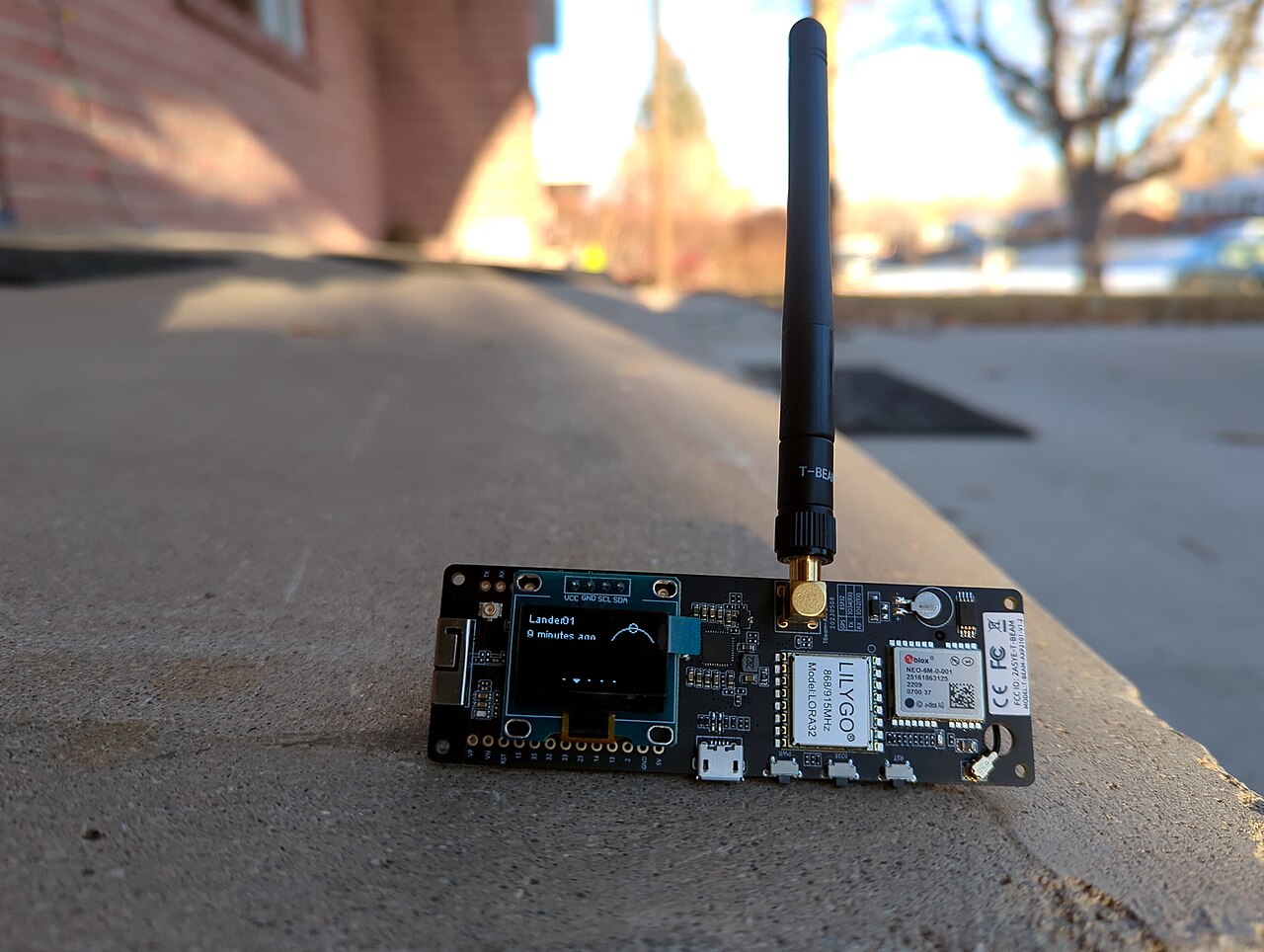
Meshtastic node hardware compared: Heltec V3, T-Beam, T-Echo, T1000-E
Meshtastic node hardware compared: Heltec V3, T-Beam, T-Echo, T1000-E
Our earlier guides covered the first node checklist and what Meshtastic encryption does and doesn't protect. The question that comes next is always hardware: which board do you actually buy? We stock four, and they are not interchangeable — the differences are battery chemistry, microcontroller family, display and GPS, and they decide whether your node lasts a weekend or a week.
The line-up at a glance
Meshtastic's own supported hardware overview recommends the newer SX126x radio family over the older SX127x for performance and compatibility — all four boards below comply — and shows how much the choice comes down to the microcontroller: ESP32 boards have WiFi and more memory; nRF52 boards sip power. A recent third-party Meshtastic vs MeshCore hardware comparison reaches the same conclusions we do: Heltec for budget, T-Beam for mobile tracking, T-Echo for battery life.
| Board | MCU | GPS | Battery | Display | Our price |
|---|---|---|---|---|---|
| Heltec V3 (cased) | ESP32-S3 | No | External LiPo | 0.96" OLED | A$49.28 |
| LILYGO T-Beam (SX1262 + GPS) | ESP32 | Yes | 18650 holder | No | A$51.97 |
| LILYGO T-Echo | nRF52840 | Yes | Built-in 850 mAh | 1.54" e-ink | A$111.78 |
| SenseCAP T1000-E | nRF52840 | Yes | Built-in LiPo | No | A$92.04 |
A note on what "complies" means above: the Heltec V3's SX1262-based spec sheet lists the same radio Semtech's datasheets rate at up to +22 dBm, and the firmware's AU region preset keeps it inside the class-licence envelope out of the box. Where a board needs attention is firmware version — more on that below.
Heltec V3: the budget node that teaches
The Heltec V3 is the cheapest credible entry point and the board most community guides treat as the default first node. ESP32-S3, OLED display, USB-C. Its gaps are deliberate: no GPS and no built-in battery, which keeps the price down and forces you to learn the app pairing flow before you invest in hardware you don't need. As a fixed home node on mains power, or a bench unit for learning, it is the right answer. Cased, it survives a shelf or a windowsill.
Two things to know before you buy one. First, the ESP32-S3 runs warm-ish for a Meshtastic node — not throttle-hot, but a cased Heltec on a sunny windowsill runs a few degrees warmer than an nRF52 board would. Second, the OLED means it draws meaningful standby current, so it wants mains power or a decent battery. Trying to make a Heltec V3 into a week-long bush node is fighting the hardware; that's the T-Echo's job.
T-Beam: the mobile tracker
The T-Beam adds an onboard GPS and an 18650 battery holder, which makes it the natural vehicle node or bushwalk companion — position reports come from the board itself, and 18650 cells are replaceable anywhere. LILYGO's T-Beam documentation covers the variants: you want the SX1262 radio version for Australia, and the AXP192 power-management chip means you can watch and budget every milliwatt from software, which matters once you're logging GPS fixes on the move. The trade-off is power draw: an ESP32 plus GPS consumes far more than an nRF52, so expect to charge it more often than a T-Echo owner would. Our StealthMesh Field Kit builds on exactly this platform with a solar option.
If you're mounting one in a vehicle, spend your first evening on two settings: fix intervals (a GPS fix every 30 seconds instead of every 2 doubles battery life on a day trip) and the node role — CLIENT for anything portable, because a ROUTER role node relays for everyone and will chew airtime and battery doing it.
T-Echo: the week-long node
The T-Echo pairs the nRF52840 — the ultra-low-power microcontroller Meshtastic's hardware docs favour for battery operation — with an e-ink display and a built-in 850 mAh battery. Deep-sleep current is measured in microamps, so an idle T-Echo holds out for a week or more of intermittent use. The e-ink screen costs nothing to keep showing your node's battery and last fix, which is genuinely useful on a node you check weekly. It is the node you hand to a family member who will never charge anything. The cost is the price: roughly double the Heltec.
Seeed's T1000-E datasheet documents the same nRF52840 + LR1110 combination in card form, and their consumption-test notes are a useful reality check on how radio duty cycle dominates battery life on nRF52 boards — GPS polling and airtime matter far more than the display.
T1000-E: the asset tag
The SenseCAP Card Tracker is a different shape of product — a credit-card tracker with no display, designed to be clipped to a dog, a bike, or a bag. nRF52840 inside, GPS onboard, phone-app pairing, 6.5 mm thick with a charging puck rather than a USB port. If you want "where is my stuff" off the commercial find-my networks and onto a mesh you control, this is the pick. Honest limitation: the sealed case means you can't swap the battery, so plan on the tracker's service life rather than treating it as a forever node. And its tiny internal antenna gives it less range than any of the boards above with a proper whip — fine for around the property, less fine as a bushwalker's lifeline.
The Australian licensing facts (current as of October 2026)
Meshtastic in Australia runs on 915–928 MHz under the ACMA low interference potential devices (LIPD) class licence — no application, no fee, but hard conditions. The Radiocommunications (Low Interference Potential Devices) Class Licence 2025, which commenced 1 October 2025, permits 915–928 MHz digital-modulation transmitters at up to 1 W EIRP under its digital-modulation conditions; generic non-hopping 915–928 MHz operation sits at 3 mW. In practice: keep the stock antenna or our LoRa whip (A$9.80), buy 915 MHz hardware, and stay within the class licence limits. Buying an 868 MHz European variant is a mistake in Australia — it is outside the permitted band.
One practical wrinkle worth knowing before you flash anything: Meshtastic firmware defaults the radio to the region you pick in the app, and the AU setting enforces the right duty-cycle behaviour for 915–928 MHz. Older firmware images floating around some marketplaces predate the 2025 class licence and its power limits — flash current official firmware from the Meshtastic device list rather than whatever a reseller shipped.
What we'd buy
- Learning and home node: Heltec V3, or the two-node starter kit (A$64.90) so you can see hops happen.
- Bushwalking and vehicles: T-Beam, ideally in the Field Kit.
- Long-battery-life handheld: T-Echo.
- Clipped-on tracking: T1000-E.
If the budget only stretches to one board, buy the starter kit over a single nicer node — two cheap nodes teach you more about what the mesh does than one expensive one ever will. That's also the honest answer to "how far does it reach": it depends on the second node's antenna more than the first.
All of these are for lawful use on the LIPD class licence — set sensible roles, respect airtime, and the mesh works better for everyone.