"Build a desktop flight radar: ESP32-C3, a round display and real ADS-B"
Build a desktop flight radar: ESP32-C3, a round display and real ADS-B
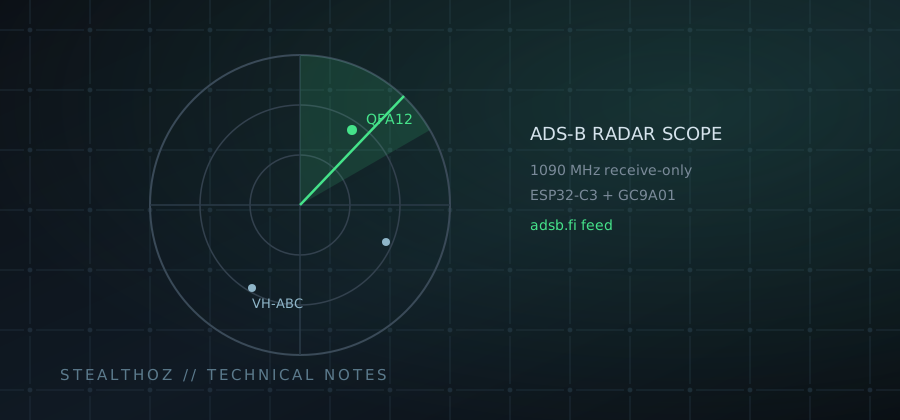
A retro radar scope on your desk, sweeping away, with real aircraft plotted at their real positions, is one of the most satisfying things you can build for about fifty dollars. Mateusz Juszczyk's ESP32-Plane-Radar project does exactly that: an ESP32-C3 Super Mini, a GC9A01 round display and a 3D-printed bezel, pulling live ADS-B air traffic over Wi-Fi and rendering it as a classic radar display. Hackaday featured it in July 2026, noting the best part is how easy it is to build along. This guide covers the build, the data sources it can use, and the step up to a genuine 1090 MHz receive station if you get hooked. Everything here is receive-only, and everything it receives is broadcast publicly by the aircraft themselves.
How ADS-B works, in two paragraphs
ADS-B stands for Automatic Dependent Surveillance-Broadcast. Aircraft fitted with it (in Australia, all IFR aircraft must carry it, and increasingly VFR aircraft do too) transmit their position, altitude, velocity and callsign about once per second over 1090 MHz, unencrypted, for the benefit of ground stations and other aircraft. As CASA's Flight Safety Australia publication explains, the system was rolled out across Australian airspace precisely because it lets ground surveillance cover terrain that radar cannot see. That same transmission is what FlightRadar24 and FlightAware display, and it is what hobbyist receivers pick up.
Because the data is broadcast in the clear for anyone to receive, listening to it is lawful in Australia. The ACMA regulates the equipment you can transmit with, not a receiver decoding a public broadcast. You should not transmit anything on 1090 MHz (that frequency is reserved for aviation safety systems, and interfering with them is a serious offence under the Radiocommunications Act), but a receive-only setup never goes near that line. The radar-scope build we're covering doesn't even have a radio receiver on board in the classic sense: the ESP32-C3 fetches decoded aircraft data from adsb.fi's open API over Wi-Fi, which is about as lawful-boring as RF-adjacent hardware gets.
The scope build: parts and flash
The bill of materials is short:
- ESP32-C3 Super Mini - a few dollars from any AU electronics supplier, or the controller side of our ESP32 dev board starter kit (A$45.45) if you want the full parts pack.
- GC9A01 round display (1.28 inch, 240×240) - sold as a "round LCD module", widely stocked.
- USB power - the whole thing draws under an amp from a phone charger.
- A 3D-printed bezel if you want the professional look; the project repo links the files.
Firmware is flashed over USB from the Arduino IDE or PlatformIO using the repo's source. Once configured with your Wi-Fi credentials and your coordinates, it queries the adsb.fi endpoint for aircraft within a radius of your location, converts latitude and longitude into bearing and distance, and plots them as blips on the round display, complete with a rotating sweep line and range rings. Data updates every second or so. adsb.fi is a volunteer-run, ad-free aggregation network, which is one reason the project chose it.
The Hackaday write-up makes the point worth repeating: the presentation looks expensive, but the parts are cheap and the software is the whole show. Expect a first-light afternoon, most of it spent on display wiring.
Reading the scope: what the blips actually tell you
Before you add a single component, it is worth understanding what you are looking at, because the display compresses a lot of information into a few pixels. Every blip is one aircraft, placed at its bearing and distance from your receiver. Blip size on the original project roughly tracks altitude, so a large blip near the edge of the scope is a high-altitude cruiser passing at extreme range, while a small one at the same range may be a light aircraft at a few thousand feet. Your local airport's movements become a rhythm you will learn within a week: departure banks in the morning, arrivals stacked up in the evening, the overnight freight runs almost alone on the scope.
The project also has a details mode that names the selected aircraft, so you can cross-check against a flight tracking site and confirm your scope agrees with the professionals. That cross-check is also the fastest way to diagnose problems: if the scope shows aircraft that a site like FlightRadar24 does not, you are seeing gaps in the public network's coverage in your area, which is exactly the gap your own feeder would fill.
Expect the first flight to find you, not the other way around. Within an hour of first light on the display, something unusual (a helicopter doing circuits, a light twin on a survey line) will draw your eye, and you will be checking its callsign. That moment is what the build is for.
Troubleshooting the first-light afternoon
Two issues account for most of the pain in the first session. First, display wiring: the GC9A01 modules ship with several pin-label conventions, and a screen that stays black or shows garbled noise almost always means a mismatch between the wiring and the display driver selected in the firmware. Work through the repo's documented pin map before suspecting hardware. Second, location data: the scope needs your coordinates reasonably accurate (a few kilometres is fine) and the query radius set sensibly for your location. Inner-city builders should shrink the radius to avoid a cluttered display; regional builders should grow it, because aircraft are sparse.
Once it is stable, the build runs for weeks unattended off a phone charger. The ESP32-C3 generates little heat and the round display is happiest at moderate brightness, so there is no thermal story to worry about.
Step up: become a real feeder
The scope gadget is a viewer; someone else's receiver feeds it. Running your own receiver closes the loop, and this is where the hardware overlaps with the SDR gear we cover in SDR starter projects:
- An RTL-SDR v4 kit (A$54.99) decodes 1090 MHz without modification.
- An ADS-B antenna (A$34.90), tuned to 1090 MHz, is the single biggest range upgrade over the stubby stock antenna. Height and sky visibility matter more than gain.
- A 1090 MHz filtered LNA (A$29.90) placed at the antenna end of the coax typically doubles or triples the aircraft count in suburban areas by rejecting FM-broadcast overload.
Software side, dump1090 runs happily on anything from a Raspberry Pi to the Orange Pi Zero 3 (A$59.01). Feed the output to adsb.fi, ADS-B Exchange or FlightRadar24 and most aggregators give feeders a free premium account. Placing a receiver near the coast or on a rural property fills coverage gaps that city feeders leave, which is genuinely useful to the aviation-watching community.
AU-specific notes
Three practical points for Australian builders:
- Reception is lawful, transmission is not yours to make. Keep the rig receive-only. If you later experiment with anything that transmits, the lawful WiFi testing rules are the closest Australian framework worth reading, and the same principle applies harder on aviation frequencies.
- Coverage reality. Australia is enormous and feeder density is thin outside the capitals. A coastal or high-ground receiver in a regional area contributes more than a fifth rooftop in Sydney.
- MLAT is not a thing for you. Multilateration (position fixing by timing) is the aggregator's job; a single receiver only sees aircraft within line-of-sight, typically 150 to 400 km depending on altitude and antenna. Honest expectations keep the hobby fun.
Parts list, AU-priced
- ESP32 dev board starter kit - A$45.45 - controller and parts for the scope
- GC9A01 round display - from AU suppliers, a few dollars
- RTL-SDR v4 kit - A$54.99 - real 1090 MHz receiver
- ADS-B antenna - A$34.90
- Filtered LNA for ADS-B - A$29.90
- Orange Pi Zero 3 (A$59.01) - feeder host, add the case kit (A$29.90) and AU-plug PSU (A$24.90)
Affiliate disclosure: products linked are our own store.
Build order: scope first (it is the hook, and it teaches you the data model), receiver second, feeder third. By stage three you will have a desk toy, a working 1090 MHz station, and a spot in a worldwide network, all from hardware that only ever listens.