"Anatomy of the ShinyHunters PeopleSoft campaign: one zero-day, FBIJobs.gov, and a Fortune 500 targeting spree"
Anatomy of the ShinyHunters PeopleSoft campaign: one zero-day, FBIJobs.gov, and a Fortune 500 targeting spree
Most people who think about web-facing HR systems think about them as back-office plumbing. ShinyHunters just demonstrated why that framing is dangerous: the group claims it entered the FBI through a zero-day in Oracle PeopleSoft, the US bureau's job portal, then pivoted into FBI-managed AWS GovCloud storage and walked out with what it claims is 2 to 3 terabytes of personnel and applicant data, including health records and information on family members. Even if some of the group's claims are inflated, the verified core of the story, confirmed by 404 Media and the FBI's own statement, is that an internet-facing workforce-management platform was the entry point to a national-security agency's crown jewels.
The timeline
- 15 May 2026: the FBI publishes a FLASH advisory about ShinyHunters through IC3. The group later cites this document as its motive, which is worth noting for the sheer operational irony: the government body producing threat intelligence became the campaign's target.
- 22 September 2026: ShinyHunters tells BleepingComputer it used a new, unpatched PeopleSoft zero-day for remote code execution, defaced apply.fbijobs.gov with its Umbreon logo, and exfiltrated data into GovCloud-hosted stores. The FBI confirms it is investigating; it does not confirm breach details.
- Late September 2026: 404 Media reports the group sent a sample of roughly 5,000 purported FBI employee records, some of which 404 verified as accurate, and later says the group claims it will not publish the full trove. Hackaday's threat coverage summarises the situation alongside reports of Pentagon personnel data surfacing in the same ecosystem.
- Early October 2026: reporting on a detained suspect allegedly helping the FBI identify group members, and KillSec, a different ransomware brand, losing its 16-year-old operator to Spanish police. The ecosystem is being squeezed, which historically makes it more dangerous, not less, as actors burn access while they still have it.
How the campaign works, structurally
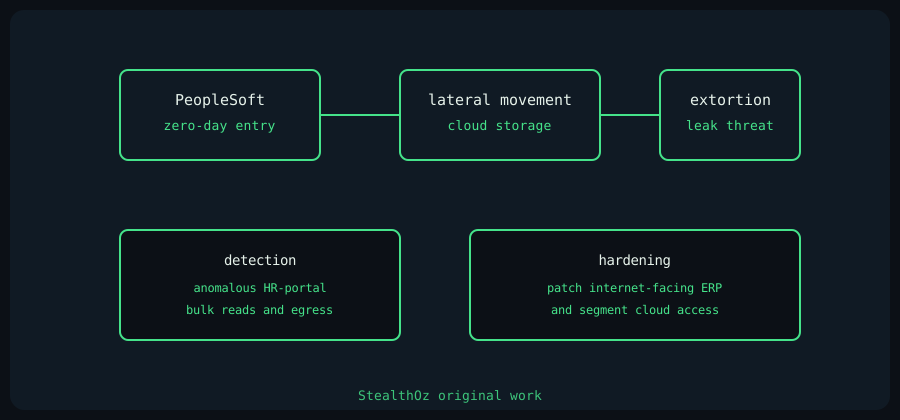
Strip away the headlines and the campaign is a textbook extortion-finance loop, and every stage has a detection opportunity:
- Initial access via a business-critical web app. PeopleSoft sits in the same category as Ivanti, Citrix, Zimbra and Fortinet: a monolithic, internet-reachable application with a long code history and an admin surface nobody loves. The group claims it found the zero-day itself, "found another one yesterday", in its own words, which signals a team with enough people to run a discovery pipeline, not just purchase access.
- Pivot to identity and cloud storage. The claim that data came out of AWS GovCloud matters more than the defacement. Modern ERP and HR stacks hold their treasure in cloud object storage and databases reachable from the application tier, so the application compromise becomes a credential problem. Session tokens, service accounts and cloud keys configured for the app are the pivot assets.
- Anti-forensics. ShinyHunters says it erased evidence to keep the zero-day unidentifiable. Log deletion is itself a detection event: gaps in audit trails, sudden rotation, or an app server whose log volume drops to zero are all findings.
- Extortion without ransomware. No encryption, no double-extortion encryptor: the product is the threat of publication. This is why Google's earlier reporting on ShinyHunters targeting the education sector through Oracle exploitation described the same loop; the FBI case is the education-sector playbook scaled up and pointed at a government agency.
- Reinvestment. The group says it is now working through Fortune 500 targets with the same bug. A single research effort amortised across many victims is the economic engine of the extortion industry.
Detection: what to instrument before you need it
If you operate PeopleSoft, or anything in its family, put these on the dashboard now:
- Authentication telemetry out of the web tier, not just the database. Any pre-auth code execution shows up first as malformed requests, unusual parameter shapes, or error-rate spikes on authentication endpoints.
- Egress from the application tier to object storage. Normal PeopleSoft behaviour does not include the app server bulk-reading thousands of employee records and writing large archives. Volume-and-velocity alerts on reads of person, address, and payroll tables catch step 3 before the data leaves.
- Cloud-side monitoring. Wherever the data lives (AWS, Azure, on-prem), alert on access-key use from unexpected principals, and version object storage so deletions are recoverable and evidence is preserved.
- Log integrity. Ship logs off-host in real time. Anti-forensics depends on the victim having only one copy.
- The downstream data flow. For an organisation with HR data about its staff, the personal-data impact is the breach, whether or not systems get defaced.
Patching is the multiplier for all of this: organisations that applied Oracle's PeopleSoft updates for the 2023 MOVEit-era wave and subsequent CVEs are structurally harder to enter through this path than those treating HR systems as set-and-forget.
Australian impact
- Who is in scope: Australian APP entities running PeopleSoft, SAP, Workday or similar HR platforms hold "sensitive information" (health, and for many records, family and contact details) at scale. A ShinyHunters-style exfiltration is an eligible data breach under the NDB scheme, triggering notification to the OAIC and affected individuals. The group's demonstrated interest in health and family data of personnel makes the sensitive-information threshold easy to meet.
- Essential Eight mapping: Patch Applications is the primary control and this incident is a live argument for treating HR/ERP platforms as patch-priority-tier-zero alongside Citrix and VPN gateways. MFA and Application Control raise the cost of the post-exploitation stages, and Regular Backups plus cloud-side versioning blunt the extortion leverage. The framework guidance is at ASD's Essential Eight page.
- ReportCyber: Australian organisations that find this activity, or receive ShinyHunters-style extortion demands, should report through cyber.gov.au and consider notification to the OAIC in the same incident-response cycle, not sequentially.
- Supply-chain reality: many Australian organisations consume HR as a managed service, so your exposure depends on your provider's patching. Our guide to auditing your own privacy posture walks through supplier questions worth asking, and our 2026 breach-notification analysis covers what the notification regime demands in practice.
The uncomfortable takeaway: the FBI had a FLASH advisory about this exact group and it did not prevent the breach, because the group found a fresh bug in a class of system nobody treats as a perimeter. Every Australian HR system on the public internet is in the same class, and only a few of them have the monitoring to notice the day the bulk reads start.
There is a personal angle too, and it is not just a government problem. The stolen records reportedly include addresses, family details and health information of staff, the exact combination that makes people extortable and doxxable, and the same profile that Australian public servants, police officers, and even corporate HR systems hold. Employees who are personally worried about their HR data being exfiltrated can tighten their own position: phishing-resistant sign-in is the single best personal control, and a hardware token such as a FIDO2 security key stops the credential-theft stage of any follow-on attack that uses stolen HR data for spear-phishing. For organisations, holding less is the other lever: retention limits on old applicant records shrink the blast radius of the next PeopleSoft-class bug, and encrypted off-site archives mean a cloud-bucket compromise does not equal a plaintext compromise. If you keep the keys to those archives yourself, the Steel Seed backup plate is one way to store recovery secrets outside the cloud entirely.
This post is general security information, not legal advice.
Sources: BleepingComputer: ShinyHunters claims FBI hack via PeopleSoft zero-day · 404 Media: FBI hackers say they won't publish the trove · FBI IC3 FLASH advisory on ShinyHunters (May 2026) · Google Cloud threat intel on ShinyHunters and Oracle exploitation · Hackaday This Week in Security, 2 October 2026